The Patent — The Patented Technology of AQ SHIELD Marine Coatings
No leaching, no external power, no magnetic alignment — and yet it keeps fouling off. This page unpacks the “why,” following the patent gazette itself.
Movie
A Hull Coating That Needs No Power? — The Video
Ren explains this page in plain words (about 2 minutes 20 seconds). The mechanism is, in the patent itself, a presumption; the immersion-test results are measured fact — the video keeps that line clear, so you can grasp the whole picture before the details.
Introduction
About This Page
This page is a technical explanation, written for specialist readers, based on the patent gazette for Japanese Patent No. 7936642 — title of invention: “Marine Organism Antifouling Coating” — which underlies the antifouling technology of AQ SHIELD MARINE / MARINEα. All figures, test conditions and evaluations are quoted as stated in the gazette, and the mechanism of action, which the gazette presents as a presumption, is stated as a presumption here.
On this page, “marine coating” as a technology term covers vessels, marine structures and coastal infrastructure — the scope of application contemplated for the patented technology. The products MARINE / MARINEα are for hull bottoms only, exactly as on the homepage.
Films made of resin born of petroleum are exposed continuously to ultraviolet light and oxygen, and are slowly oxidized — fading and cracking as they go. Silica (SiO2), by contrast, is silicon fully oxidized, a finished substance: there is no further oxidation left for it to undergo, and ultraviolet light does not break it down. That is why crystal keeps its brilliance for millennia. The AQ SHIELD film is a glass-like film with this silica skeleton.
Petroleum-based organic resins degrade — chalking, yellowing and cracking — as ultraviolet light and oxygen sever the carbon bonds that form their skeleton. Si–O bonds, by contrast, are bonds in which the silicon is already fully oxidized, forming a stable skeleton that resists ultraviolet light. The film of MARINE / MARINEα is, as the gazette describes it, an organosilicon composition with this Si–O skeleton, formed as “a glass-like film with a silica skeleton.”
SilicaThe substance name, SiO2
CrystalIts crystalline form
GlassIts melted-and-solidified form
All three are the same SiO2.
An analogy
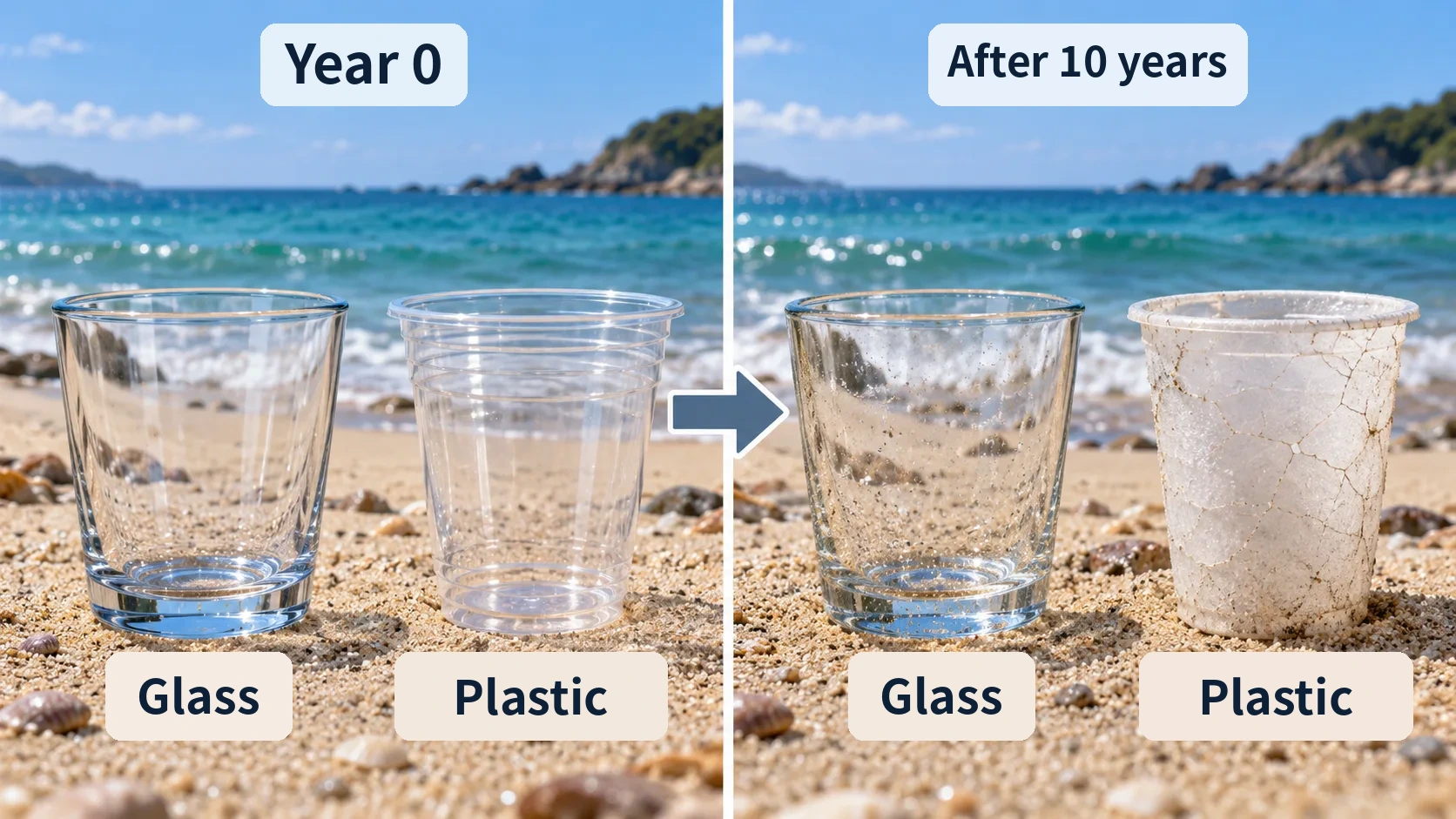
Leave a glass cup and a plastic cup by the sea. Ten years later, the glass is still clear; the plastic has clouded white with ultraviolet light and oxidation. A hull film is the same — which side its material belongs to decides how it looks ten years on.
LIQUID CRYSTAL, in the same AQ SHIELD series, also carries “crystal” in its name.
01 — History
A Genealogy of Problem-Solving
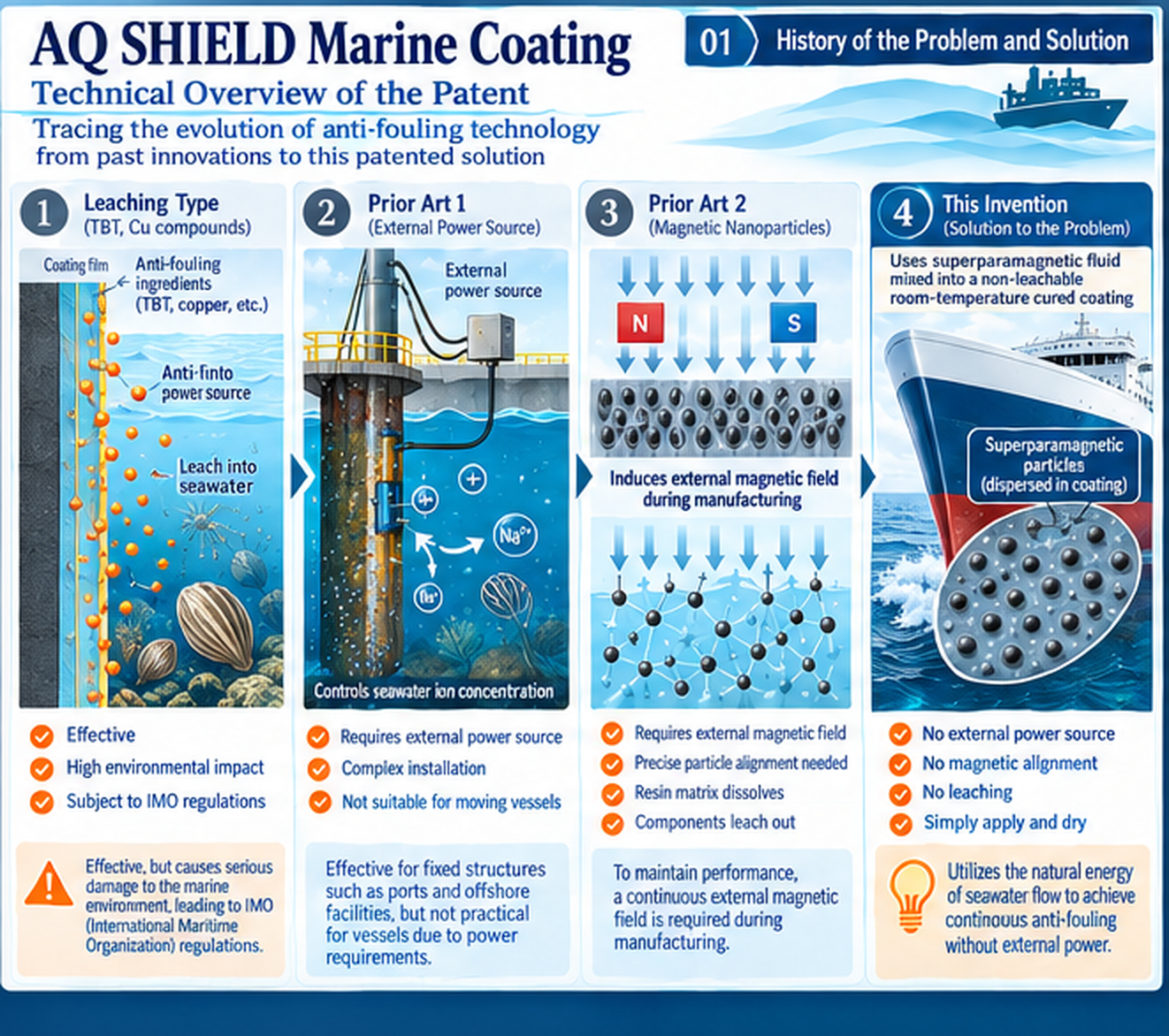
The history of antifouling technology is also a history of two walls — “works, but remains in the environment” and “gentle on the environment, but complex.” This section follows the prior art as the gazette organizes it, and where this method stands.
Leaching type — Works, but remains in the sea
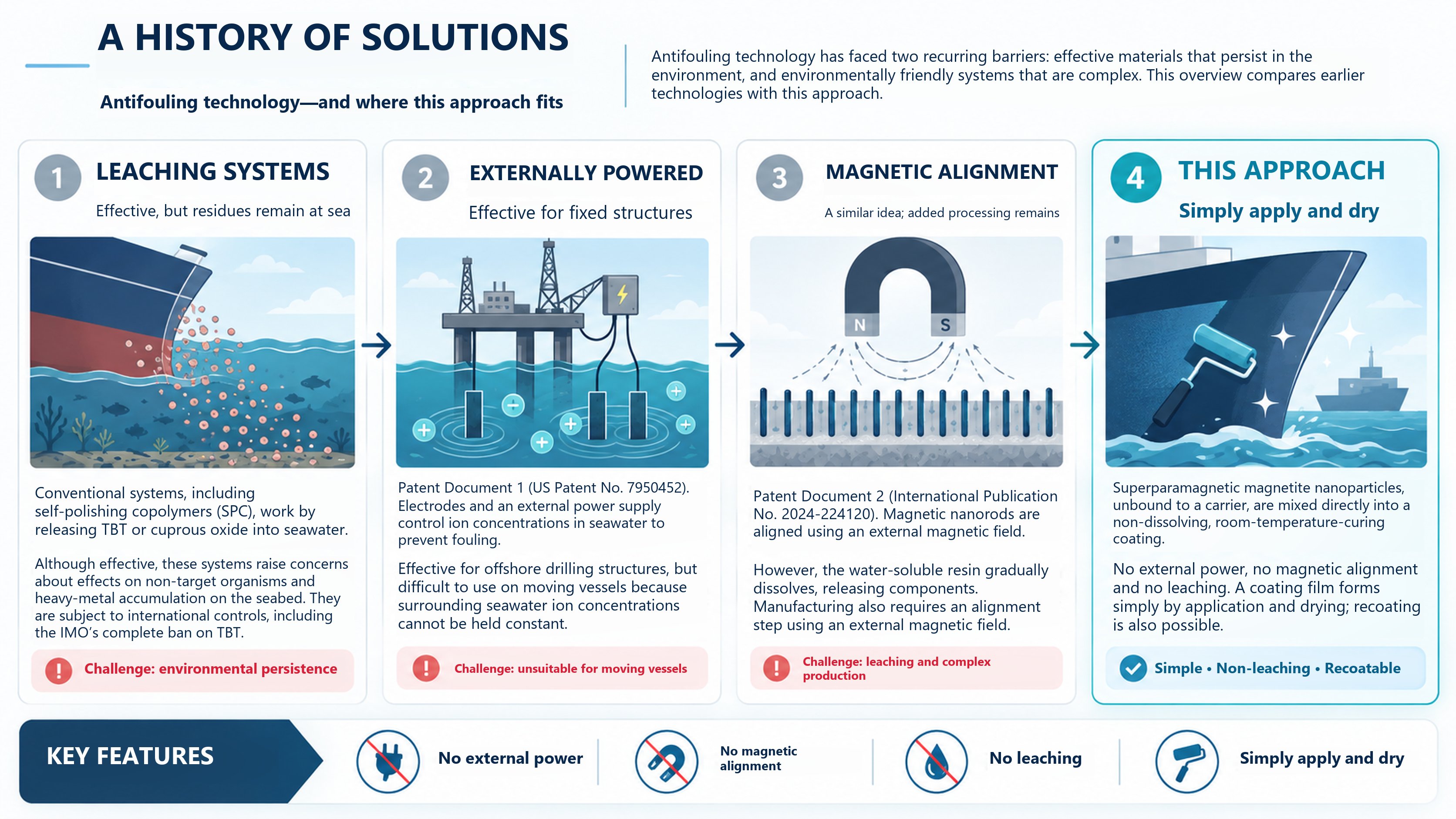
Conventional coatings, represented by self-polishing copolymer (SPC) coatings, work by dissolving TBT (tributyltin) or cuprous oxide from the film into seawater. They are effective, but their impact on non-target organisms and the accumulation of heavy metals on the seabed became a problem, and they became subject to international regulation, including the IMO’s total ban on TBT.
External power type — Effective on fixed structures, unusable on vessels
Patent Reference 1 (US Patent No. 7,950,452) is a system that places electrodes around an offshore drilling structure and uses an external power source to control the ion concentration of the seawater and prevent attachment. It may be effective on a fixed structure, but on a moving object such as a vessel the surrounding seawater ion concentration cannot be held constant, so it cannot be adopted.
Magnetic alignment type — A close idea, but leaching and effort remain
Patent Reference 2 (WO 2024/224120) aligns magnetic nanorods using an external magnetic field. However, the water-soluble resin gradually dissolves, so components are lost with it, departing from the concept of not relying on leaching. Manufacturing also requires alignment by an external magnetic field, so the film cannot be formed by simply applying and drying.
This method — Just apply it and let it dry
Superparamagnetic magnetite nanoparticles, not bound to a carrier, are mixed as-is into a non-dissolving, room-temperature-curing coating: no external power, no magnetic alignment, no leaching, and recoating is possible. The gazette positions the elimination of the prior art’s “complex compounding” as the core of its novelty.
The genealogy of antifouling technology (diagram). From left: leaching type → external power type → magnetic alignment type → this method. The difference from the prior art is the simplicity of applying it with a roller.
02 — Mechanism
How It Works — Why It Works with No External Power
Where other methods “supply energy from outside” — a power source, a magnetic field — this invention sources its energy on site. The keys are the flow of seawater and superparamagnetic nanoparticles of 5–20 nm.
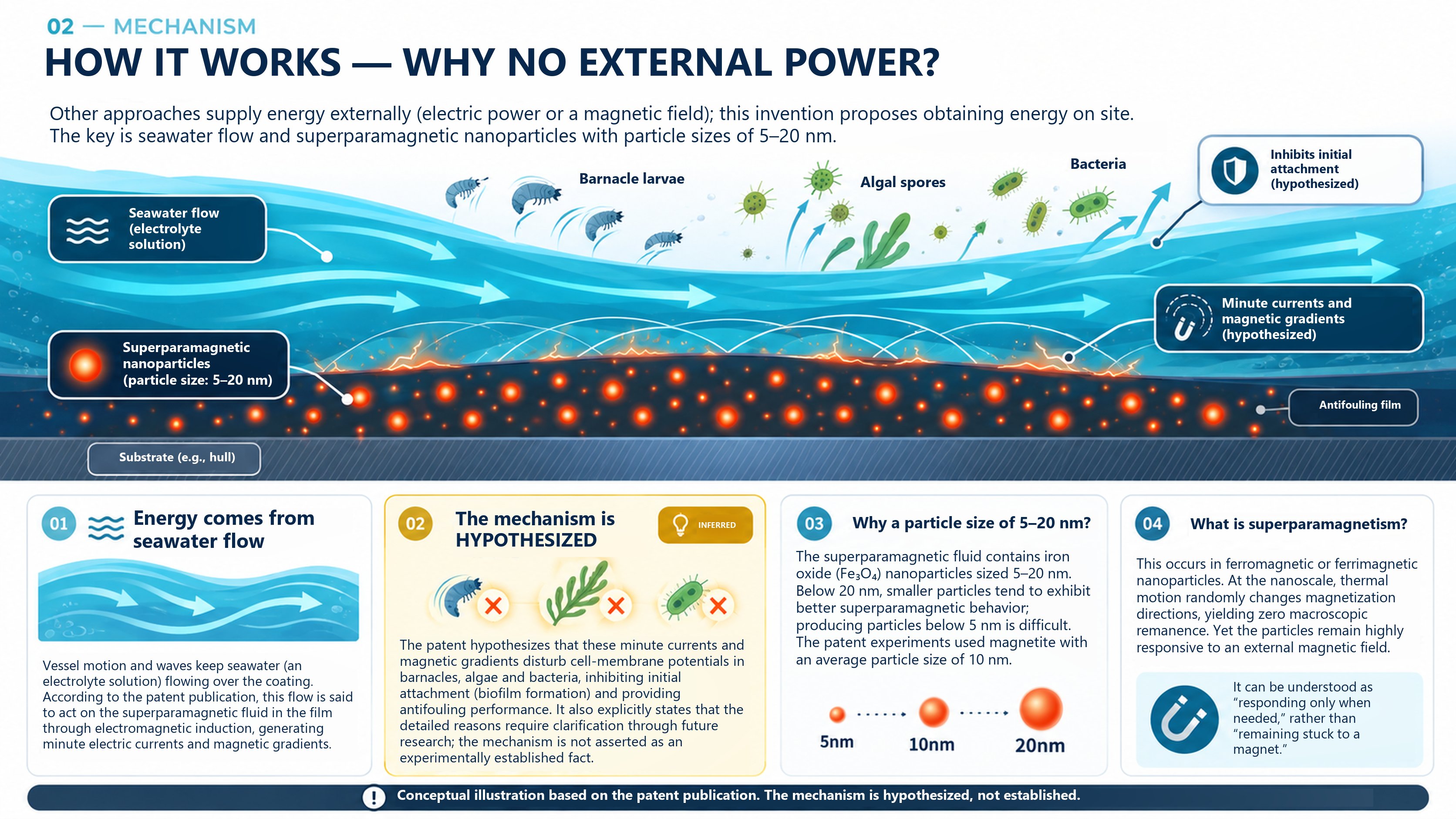
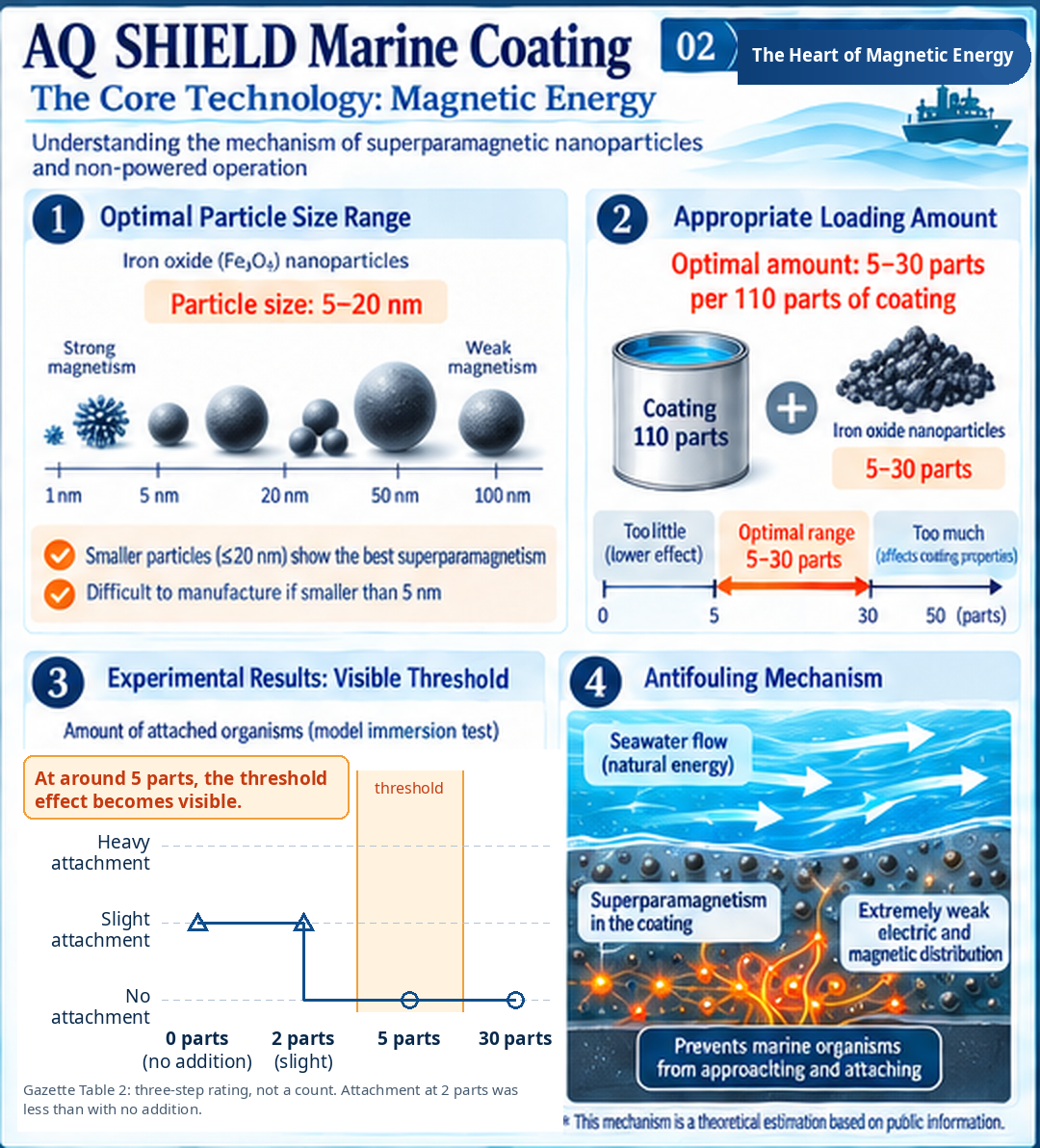
How the action is believed to work (diagram). As seawater flows over the film, minute electric currents and magnetic gradients are thought to arise between the flow and the superparamagnetic nanoparticles in the film. As stated below, this is a presumption in the gazette.
The energy comes from the flow of seawater
As a vessel travels and waves pass, seawater — an electrolyte solution — constantly flows across the film surface. According to the gazette, this flow acts electromagnetically on the superparamagnetic fluid in the film, generating minute electric currents and magnetic gradients.
The mechanism of action is a presumption. The gazette presumes that those minute currents and magnetic gradients disturb the cell-membrane potential of barnacles, algae, bacteria and the like, inhibiting initial attachment (biofilm formation) and thereby delivering good antifouling performance. At the same time, the gazette itself states that the detailed reasons must await clarification by future research, and does not assert the mechanism as an established fact. This page presents it with exactly that status.
Why 5–20 nm?
The blended superparamagnetic fluid contains iron(II,III) oxide (Fe3O4) nanoparticles of 5–20 nm. At 20 nm and below, smaller particles show good superparamagnetism more readily, while particles below 5 nm are difficult to manufacture. This physical circumstance is exactly the “window” of the claims. The magnetite actually used in the gazette’s experiments had an average particle size of 10 nm.
What is superparamagnetism?
In the gazette’s definition, superparamagnetism is a phenomenon appearing in nanoparticles of ferromagnetic and ferrimagnetic materials. In ordinary magnetic materials the magnetization direction stays aligned and the magnetized state is maintained, but at the nanoscale thermal energy randomizes the direction, so macroscopic residual magnetization becomes zero. At the same time, the very large surface-area-to-volume ratio makes the particles sensitive to external magnetic fields, with high magnetic responsiveness. It can be read not as “stuck to a magnet” but as “responds only when needed.”
03 — Composition
Composition and Performance in Numbers
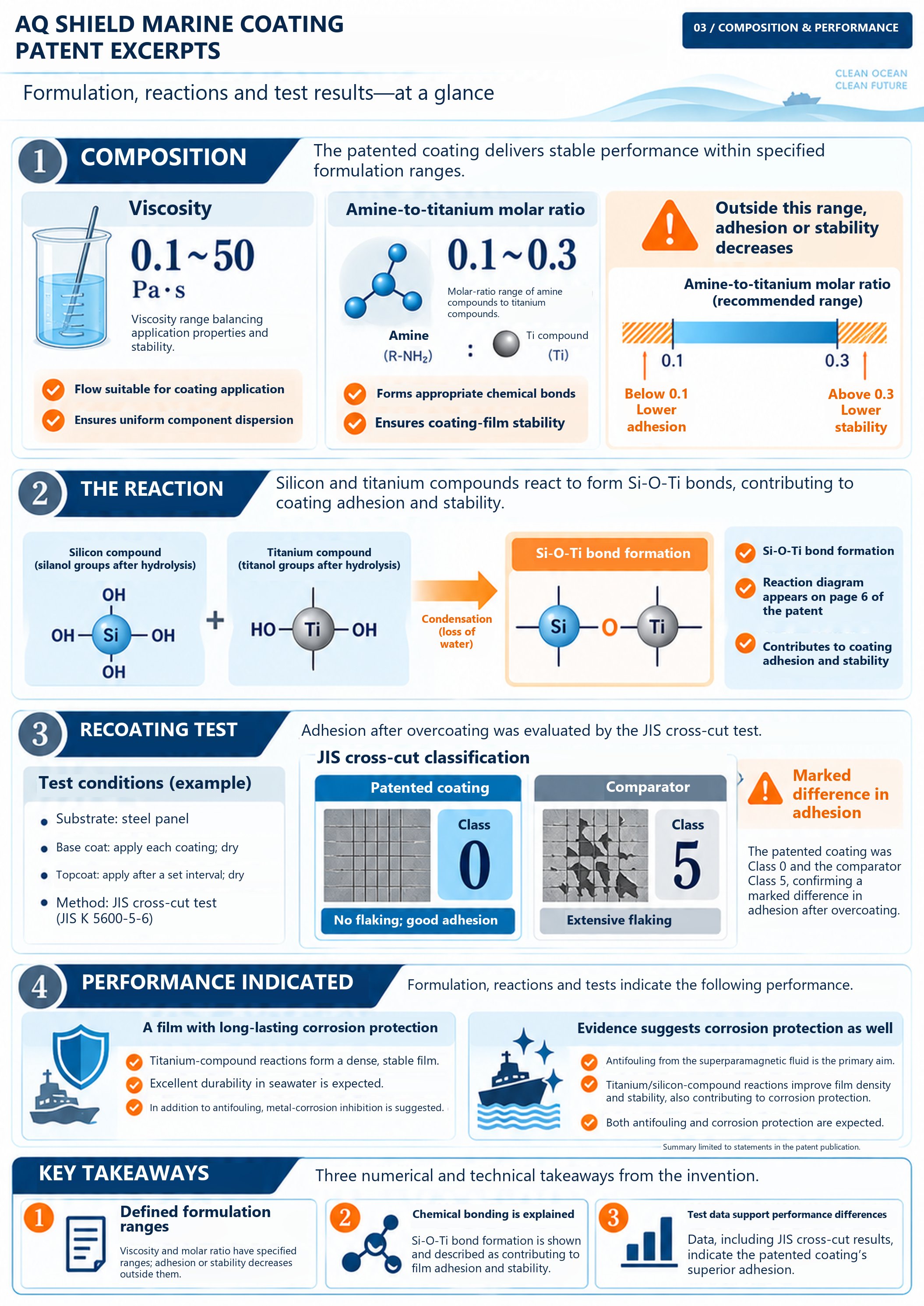
Each figure in the claims has a “why this range” in the gazette. The main figures are set out here with their reasons.
Item
Figure in the gazette
Reason for the range (per the gazette)
Superparamagnetic nanoparticle size
5–20 nm (iron(II,III) oxide, Fe3O4)
Shows good superparamagnetism at 20 nm and below; particles under 5 nm are difficult to manufacture
Superparamagnetic fluid loading
5–30 parts by mass per 110 parts of coating components
Below 5 parts, antifouling performance is inferior; above 30 parts, viscosity rises too much and the coating components’ own properties degrade
Base resin viscosity
0.1–50 Pa·s (at 23 °C; a linear organopolysiloxane with silanol groups at both chain ends)
Below 0.1, the film’s extensibility is insufficient; above 50, workability during film formation deteriorates
Reaction product molar ratio
Titanium alkoxide compound 0.1–0.3 mol per 1 mol of amine compound
Below 0.1, unreacted amine increases and adhesion to the substrate weakens; above 0.3, unreacted titanium increases and the coating’s stability deteriorates
Reaction product solid ratio
0.5–10 mass% relative to the organopolysiloxane
Below 0.5%, adhesion is insufficient and no antifouling effect is obtained; above 10%, it thickens and gels
The “reaction product” is the reaction product of a bis(trialkoxysilylalkyl)amine compound and a titanium alkoxide compound. A titanium alkoxide on its own forms white titanium oxide on contact with moisture, but this reaction product is substantially transparent and, the gazette states, far more stable against moisture.
04 — Tests
How to Read the Tests
The gazette’s experiments are designed as a dose–response — the loading varied in steps — with clearly placed comparisons, so the results can be read with their reasoning.
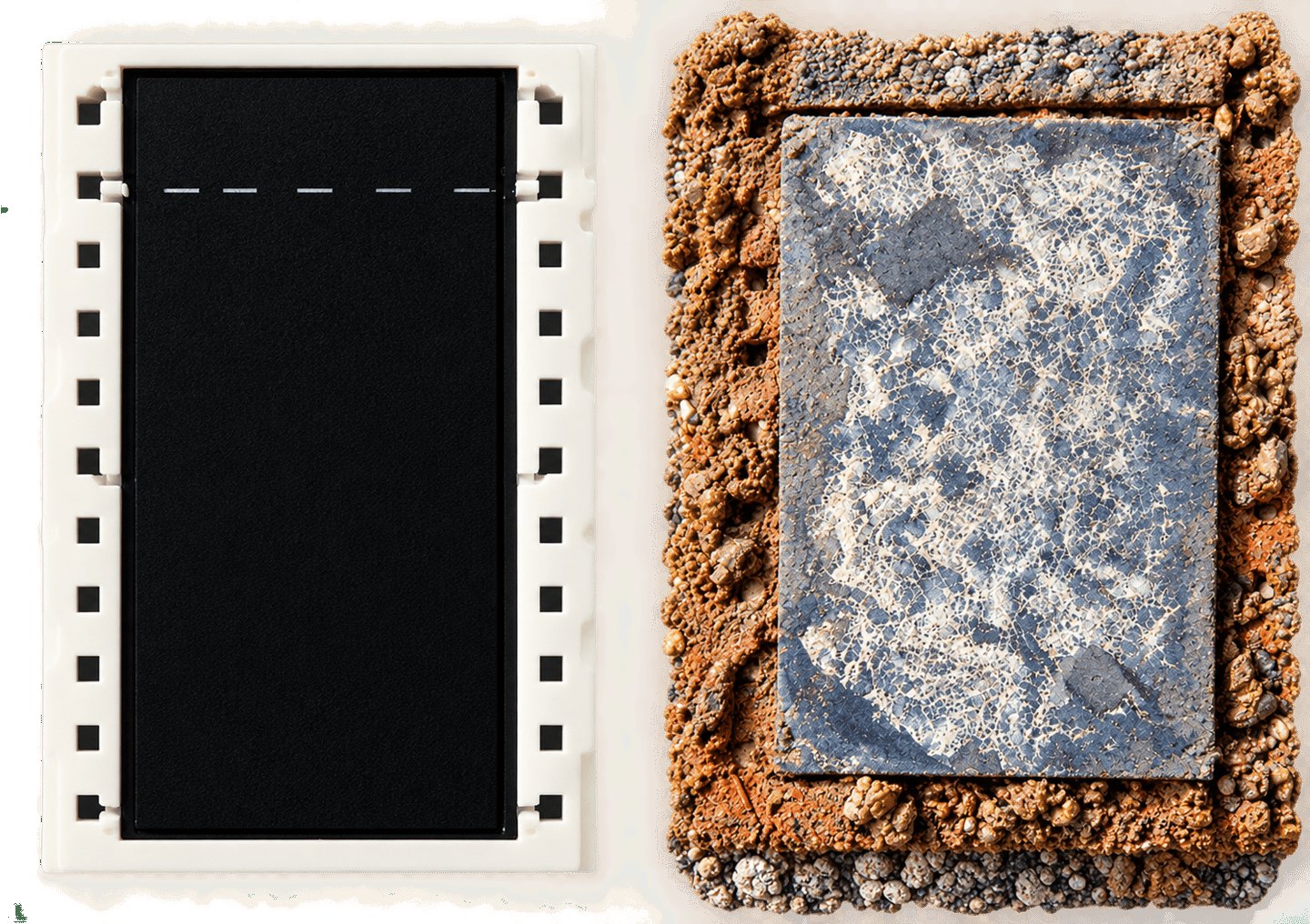
The immersion test panels (photograph).
Immersion test conditions
The specimens were FRP panels (148 × 210 × 5 mm), roller-coated, dried at room temperature for 24 hours and then cured for two weeks; they were fixed to a steel plate and suspended by rope into the sea. Location: near Otsushima Fishing Port, Tamashima, Kurashiki, Okayama. Period: 27 March to 8 October 2025 (about six and a half months), a period including the warm season when fouling organisms are active.
Loadings are parts by mass per 110 parts of coating components. Stepping from none → 2 → 5 → 30 parts shows that the threshold where the effect begins lies around 5 parts; the optimal range is 5–30 parts. The gazette notes that the commercial propeller antifouling coating is a product normally used with an epoxy primer, but was tested without the primer for the purposes of comparison.
Recoat test — Class 0 and Class 5
After recoating, adhesion was evaluated by the cross-cut method of JIS K 5600-5-6. All invention examples (Experiments 1–4) were classification 0 (no detachment); the silicone comparison was classification 5. Silicone coatings, with their strongly water- and oil-repellent release properties, are inherently difficult to recoat, and the contrast is borne out in these figures.
05 — Applications
Applications
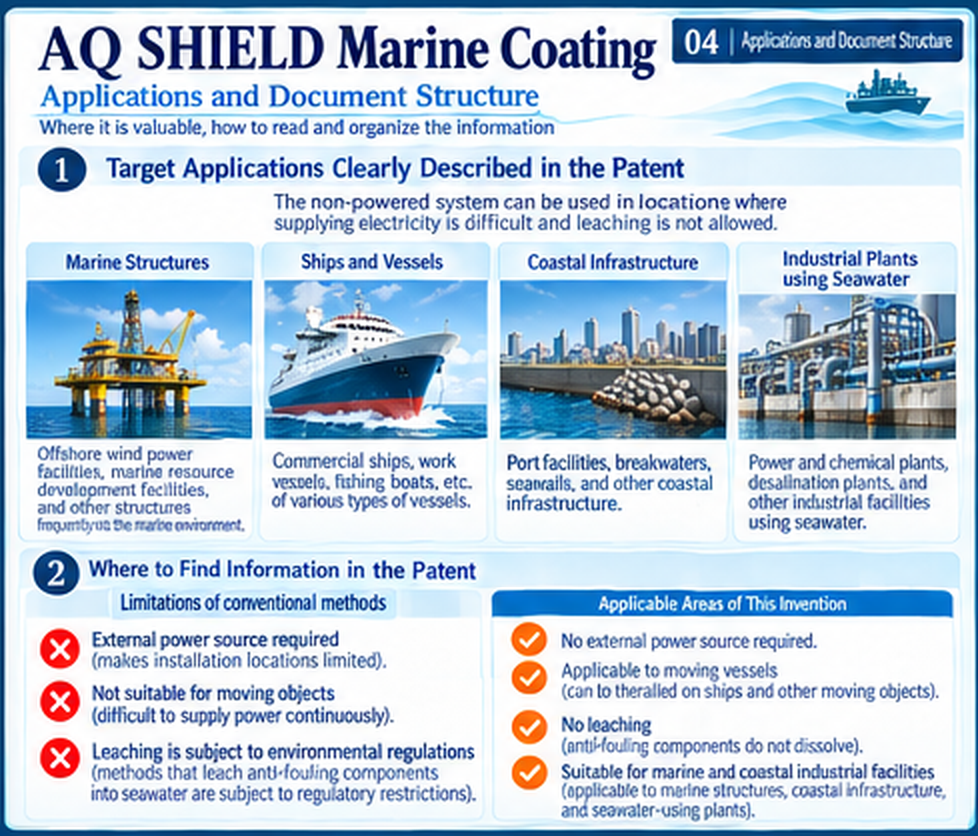
The gazette expressly names, as industrial applications: vessels, marine structures, coastal infrastructure, and industrial plants using seawater. The gazette presents this method’s position as reaching both “moving objects,” where power-based systems cannot be used, and places where leaching is not permitted.
Stated expressly in the gazette
Vessels
Marine structures
Coastal infrastructure
Industrial plants using seawater
Applications the gazette’s description brings to mind
The following are not express statements in the gazette, but associations read from its description:
Seawater intake facilities at power plants and factories (the concrete image of “industrial plants using seawater”)
Port buoys and markers
Marine equipment where securing a power supply is difficult, such as fixed fishing nets and aquaculture facilities (the flip side of “no external power required”)
06 — Prior Art
Patent Reference 3
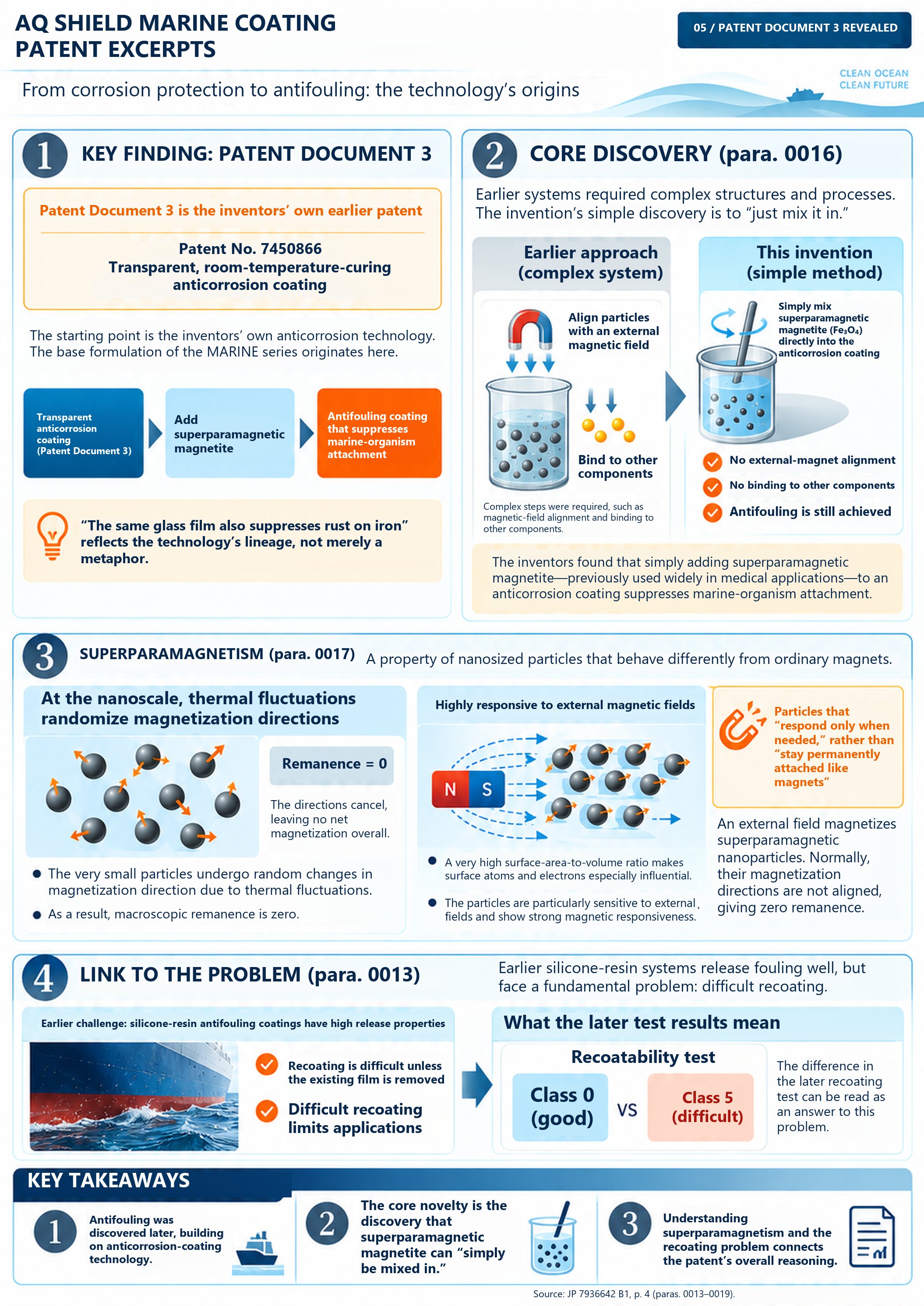
This invention’s starting point was not antifouling but rust prevention. That history tells of the technology’s other face.
The inventors’ own earlier patent
Patent Reference 3 (Japanese Patent No. 7450866), cited in the gazette, is the inventors’ own earlier patent — a room-temperature-curing transparent anticorrosion coating containing a specific linear organopolysiloxane and the reaction product of a bis(trialkoxysilylalkyl)amine compound and a titanium alkoxide compound.
The starting point of the base composition
This invention’s base composition stands in the lineage of that transparent anticorrosion coating: the starting point was an anticorrosion coating, and antifouling is a function discovered on top of it. The core of the discovery is that simply including superparamagnetic magnetite nanoparticles in that anticorrosion coating “as-is” — without aligning the particles with an external magnet, and without binding them to other components — yielded good antifouling performance.
Another face: rust prevention
The gazette also states that the combination of the reaction product and the silanol-terminated organopolysiloxane yields a film with long-life anticorrosion properties. The background to antifouling and anticorrosion coexisting in a single coating lies in this starting point.
07 — Bibliography
Bibliographic Data
The bibliographic data of the gazette for Japanese Patent No. 7936642. The patent holder is stated expressly so that the rights position is accurate.
Patent number
Japanese Patent No. 7936642 (B1)
Title of invention
Marine Organism Antifouling Coating
Application
Japanese Patent Application No. 2026-98643
Registered
7 October 2026
Gazette issued
16 October 2026
Patent holder
Fect Co., Ltd. (the developer)
Inventors
Kaito Yasuda, Yasunori Takada, Yu Kuroki and Kiyotoyo Shintani — all of Fect Co., Ltd.
Seller
AQ Co., Ltd.
This site is operated by
earth Beauty ltd (authorized distributor of AQ SHIELD)
The patent holder is Fect Co., Ltd. Neither AQ Co., Ltd. nor earth Beauty ltd is the patent holder. AQ Co., Ltd. is the seller and earth Beauty ltd is an authorized distributor; it is in those roles that we deliver the products of this technology.
Appendix
Appendix: Technical Data Sheets
English editions of the illustrated technical sheets prepared from the Japanese patent materials, summarizing the gazette. Mechanism statements in the sheets are presumptions, as noted on them.
01 — History of the Problem and Solution — how the earlier antifouling technologies differ from this method.02 — The Heart of Magnetic Energy — the 5–20 nm particle window and the 5–30 parts loading (test results as the gazette’s three-step rating).03 — Composition and Performance — formulation ranges, the Si–O–Ti reaction and the cross-cut recoat test.04 — Applications and Documentation — where the technology may be valuable.05 — Patent Document 3 Revealed — Patent No. 7450866, the inventors’ earlier anticorrosion patent, and the “just mix it in” discovery.